You're visiting a new informational site devoted solely to conifers in Zone 8A.

The Conifer Sky
There is a certain satisfaction, or sense of accomplishment that comes from creating something special. It may not be special to anyone else but you. Standing back and admiring something you've planned, designed and developed with your own hands is a joy no one can take from you. Conifer gardeners understand this.
When the bug bit...
The initial exposure 2001-2009
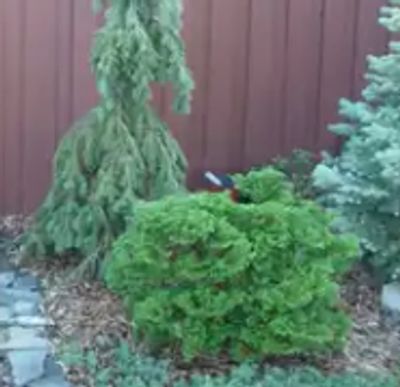
In the early 2000's I made several trips to southern Maine. The indescribable beauty of majestic spruce, fir and false cypress trees was captivating. Perhaps the most intriguing were the false cypress (Chamaecyparis obtusa) trees I saw on side trips to Rhode Island. The manicured gardens of The Breakers on Belleview Avenue in Newport contain mature Chamaecyparis trees I returned to see several times on subsequent trips to Newport. Determined to obtain one, I searched nurseries in north Texas and the infant internet to no avail. Finally, on a return trip to Maine, I located a one gallon tree in Portland. I purchased it and brought home in the overhead bin of my return flight. By this time, I'd already started the transition of my yard in Dallas to a conifer only landscape. I added my first Chamaecyparis to a nice spot that received about five hours of mid morning to early afternoon sun each day. The picture here shows it thriving about three years after it was planted. Apart from the few conifers found locally, this was one of my earliest successes that convinced me I could get conifers rarely seen in this area to live here.
Within five years my yard was full. I was out of space. But my desire was for more! In 2009 I found acreage in the far northeast corner of Texas. It was a gem in the rough to say the least, but from the first time I saw the setting I could imagine it totally transformed into a large conifer park.
From 2009 to Today

A few statistics on this location:
- This area was rezoned from 7B to 8A in 2012.
- Elevation is 449.9' above sea level
- Average rainfall 47.89" per year
- Average annual low temperature 52°
- Average low temperature in January 30°
- Average annual high temperature 73.3°
- ***Average high temperature in August 95°
- Average humidity in August 73%
Current conifers growing in the collection:
Alaska Cedar (Callitropsis)
Arizona Cypress
Arborvitae
Atlas Cedar
Deodar Cedar
False Cypress (Chamaecyparis)
Fir
Ginkgo
Japanese Cedar (Cryptomeria)
Pine
Spruce
Yew
When purchased, the property had 36 Loblolly Pines each in the neighborhood of 70-80 feet tall. While the Loblolly is native to the area, these trees were planted by a previous owner in the mid 1960's. They serve as foundational anchors that inspired the overall layout of the gardens. From 2009 forward numerous things were accomplished to "clear the slate" so the gardens could be planned.
At the time of purchase, the property was scarred with several "features" impeding my vision for its future. The realtor's listing described selling points such as "large shop building on concrete slab, fenced yard and privacy hedge". These are all features that were almost immediately removed (along with the original clothes lines). Like many gardeners who can see a beautiful picture on a blank canvas, I saw the property for what it could be and not as it was.
First things first...
Clearing the overgrowth
Tearing down the shop building
Tearing down the shop building

I first saw this place July 9th, 2009. The property had been vacant for eight months. Waist high weeds and wild privet made the view to the west hard to see. At the back of the property a barbed wire fence separated the yard from the field beyond. Just 300' from the fence was an awesome three acre pond. Clearing the brush to recapture this view was the first priority.
Tearing down the shop building
Tearing down the shop building
Tearing down the shop building
The fact the shop building sat on a concrete slab truly was a selling point. The fact it was obstructing the view meant it had to go. It was demolished in May 2010. The slab was perfect for future plans of an outdoor living space to accommodate larger family gatherings. Until those plans are finalized a gazebo occupies part of the slab now.
Removing cyclone fencing
Tearing down the shop building
Removing cyclone fencing
The cyclone fence, along with the volunteer privet growing in it, was removed from the entire property. This opened up the view and made maintenance easier. It also made it possible to work on the full scale long term layout without any constraints.
Gazebo added
Removing cyclone fencing
In August of 2010 I built a gazebo onthe remaining slab and started some landscaping. As plans changed, so did the landscaping. The Angelica Blue Juniper (Juniperus chinensis) loved the high humidity, high heat and direct sunlight for most of the day during summer. It exploded growing 6' wide by 4' tall. The Angelica Blue never had bagworms or blight. My plans changed and I removed it all in 2021. It is an excellent choice for a larger space and I will plant more later.
Propane tank relocated
An obvious necessity was an obvious eyesore. The propane tank was relocated to an area not so obvious. The gazebo was painted a darker color in 2011. Unfortunately, the large Loblolly to the right in the picture above and the one across the pond in the previous picture were both struck by lightning and had to be removed.
Early landscaping choices

A view of the initial plantings around the gazebo in 2010 shows juniper, chamaecyparis, a Horstmann Blue Atlas cedar and a Snow Sprite deodar cedar. The fence separating the yard from the three acres to the north was still visible in the picture above as it had not been removed at the time this shot was taken.
Infrastructure
Pathways
North retaining wall
North retaining wall
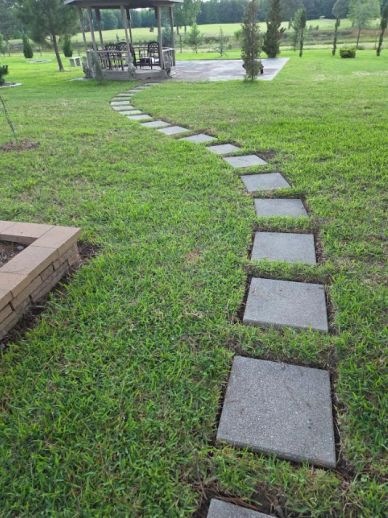
Out of necessity stepping stones were installed between the house and the gazebo. Each rain event left a muddy path between the two making it impossible to traverse without getting wet shoes. The 16x16" blocks were a quick and simple solution. These concrete stones became the option for all paths. Currently, there are over 330 in the broad "loop", Walking the circle ten times is the equivalent to one mile.
North retaining wall
North retaining wall
North retaining wall
The property gradually slopes to the west allowing for low rise walls that provide a tiered affect. The Slash Pines (Pinus elliottii var. densa) behind the Green Giant Arborvitae are among the fastest growing trees in the collection. Planted in May 2024, each has tripled in size flushing new growth as many as five times per season. Four more were planted in February of 2026 to the left to continue the "wall".
The goal is to create a privacy backdrop that makes the garden an intimate space separate from the surrounding area beyond the garden perimeter. However, the view to the west overlooking the pond will be left open as larger specimens are planned for the space between the pond and gardens.
South retaining wall
North retaining wall
The south wall is also crowned with Green Giant Arborvitae.
Bridge
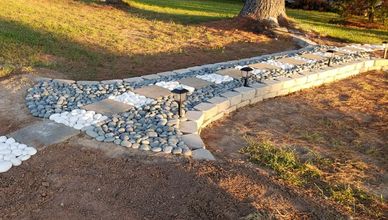
This space between two established pine trees provided the perfect setting for a bridge. The roots had raised the soil around the trunks giving the space between the trees an optical illusion as if it were a valley or low spot between the two trees. The faux bridge creates a point of interest when walking the garden loop. Shaded beneath the towering Loblollies this part of the path reminds you that you are beneath the Conifer Sky!
Arbor
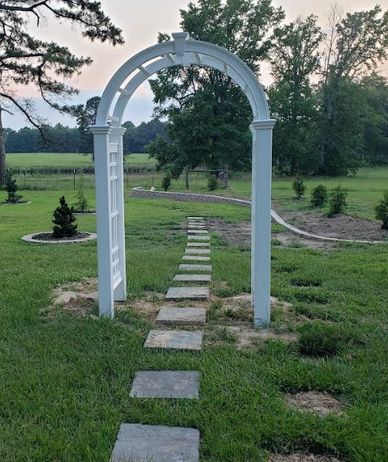
This is a great photo showing how things often get "re-routed" as plans change. The path had been laid out and blocks sunk before the arbor was purchased. Obviously, once a position was selected for the arbor the path was redirected.
Raised beds
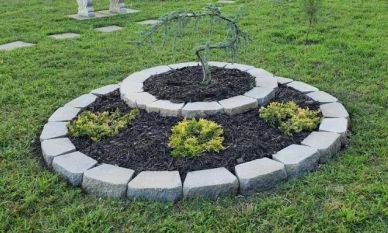
The property slopes to the west toward the pond so it has good drainage overall. However, for several beds I have raised the soil to prevent "wet feet". Few conifers will tolerate standing in water. The serpentine Blue Atlas was a victim of merciless deer grazing in 2023 to the point it was a total loss. I am happy now as the Raywood's Weeping Arizona Cypress now occupies this prominent focal point. The Gold Strike Juniper have filled in as shown in new pictures.