You're visiting a new informational site devoted solely to conifers in Zone 8A.
The Conifer Sky
Conifers in North Texas & Zone 8A. Yes! They really do live here.
You're visiting a new informational site devoted solely to conifers in Zone 8A.
Signed in as:
filler@godaddy.com
Conifers in North Texas & Zone 8A. Yes! They really do live here.
Few trees are as awe inspiring as a towering Sequoia, majestic Blue Spruce or weeping Alaskan Cedar. Unfortunately, misinformation about conifers prevents far too many from enjoying the lush year-round beauty only evergreens provide. Comments like "That won't live here" and "Planting that is a waste of time and money" cause many people to rule out any thought of selecting conifers. The truth is there are a few conifers that will not do well in this part of the United States. That said, the overwhelming majority will not only do well here, they can THRIVE here. In fact, several live here that won't live in the northern half of the country.

Travelers from the south-central United States are often mesmerized by the striking evergreens commonly seen in the northern sections of our continent. Many return home with a desire to add conifers to their landscaping. That was my story. I first caught "conifer fever" in 2001 and have been smitten with it since. My home in Dallas quickly became a conifer only domain where I was restricted to focusing on small spaces, until I ran out of space. In 2009 I bought acreage in rural NE Texas. I call Red River County home now where I continue working on an ever growing project. This site documents the conifer material I have planted and how it's performed over time. If you are in the south-central U.S. and have an interest in conifers I hope you enjoy the site. Whether you are a Conifer Purist, Conifer Enthusiast or simply Conifer Curious, hopefully these pages will have something for you!
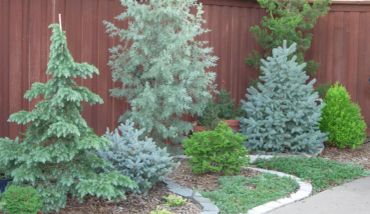
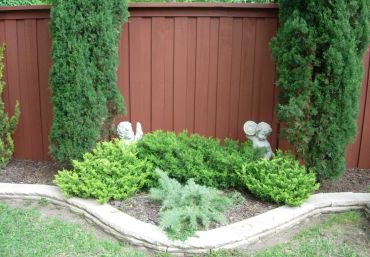
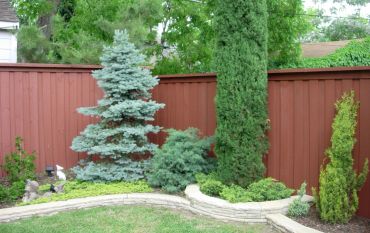

Color and Texture work together to create interest in any conifer garden. Raywood's Weeping Arizona Cypress and Gold Strike Juniper are well suited for Zone 8 and doesn't burn in hot sun.
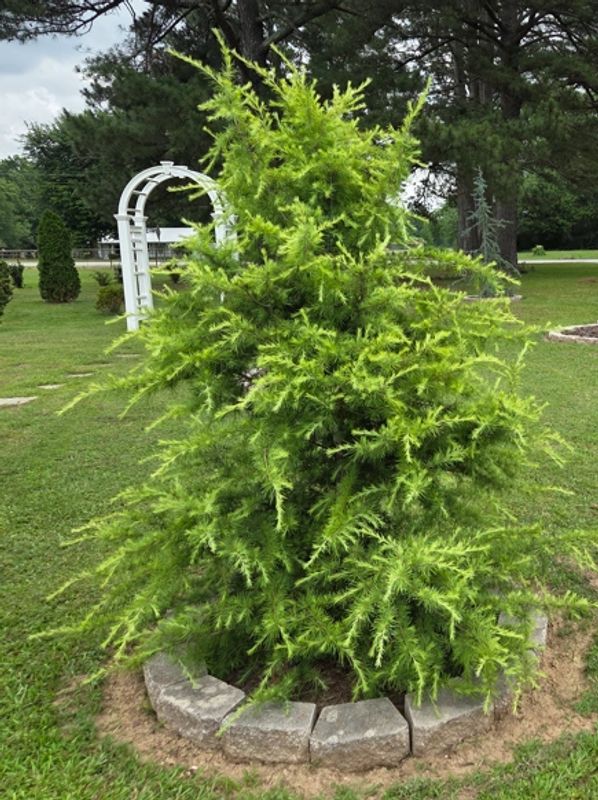
The estate size trees most conifers grow into can only be fully appreciated when planted in open spaces. Aurea Deodar Cedar flushes new growth that generates a lot of attention.
Feel free to submit questions through the Contact form below this section.
The quick answer is yes but with caveats. Growing zones are based on average low temperatures over a specific number of years. Southern venues need not be concerned with cold tolerance with the exception of a few trees. Heat is of far greater concern for southern locations. As a result, many conifers can be successfully stretched two zones south depending on the planting environment. A city may be several degrees warmer than a rural setting 30 miles from the nearest town. Temperatures inside concrete jungles are slow to drop at night where rural settings cool quickly as the sun sets. Cooler nights help conifers to thrive during southern summer conditions. Of course, good drainage, adequate water, mulch, afternoon shade (for some) and proper weeding all play major parts in how well a conifer will do in any zone..
Deer, rabbits, southern pine beetles and bagworms are all issues to monitor in southern plantings. While arborvitaes and junipers can be net wrapped during winter to help prevent deer grazing, the warmer months require constant monitoring for bugs. If bagworms appear they should be picked off and destroyed before treating the tree with an over the counter product to eliminate them fully. For beetles and other pests, systemic treatments can be "watered in" on a schedule to help prevent infestations. If plantings are in an area where infestation is likely to occur, waiting until evidence of an infestation is visible may be too late.
This depends on the specific tree. Selective pruning is best if and when needed. Proper planning for long term growth in advance of planting is better than pruning later. If maintaining a specific shape or form is desired pruning may be necessary. When deciding to prune, think "haircut". If you take off too much it may be disastrous. But taking off a little at a time and reassessing allows you to sculpt a form perfect for your garden.. Know how the tree you plan to prune will respond. Various plant material reacts differently to pruning. Some junipers accept brutal shearing and recover nicely while a blue spruce may never recover from the same treatment.
Happy to visit with other conifer fans. The site is new and will be expanding so please check back often!
Red River County Texas

Copyright © 2026 The Conifer Sky - All Rights Reserved.
The Conifer Sky exists as a reference site only.
We use cookies to analyze website traffic and optimize your website experience. By accepting our use of cookies, your data will be aggregated with all other user data.